

A note on the website lucyfromnaarm.com
In 2024 I was in an activist meeting after introducing myself and someone said to me "Oh, we have
In 2024 I was in an activist meeting after introducing myself and someone said to me "Oh, we have

Ava Cordero was 16 when Jeffrey Epstein sexually assaulted her. When she came forward in 2007, the NY Post outed her, mocked her identity, and called her a liar. Newly released DOJ files reveal what happened next.
A list of anti-transgender donors obtained by the Bash Back activist collective was deemed so damaging to the anti-transgender movement
Ava Cordero was 16 when Jeffrey Epstein sexually assaulted her. When she came forward in 2007, the NY Post outed her, mocked her identity, and called her a liar. Newly released DOJ files reveal what happened next.

Ava Cordero was 16 when Jeffrey Epstein sexually assaulted her. When she came forward in 2007, the New York Post outed her, mocked her identity, and called her a liar. Newly released DOJ files reveal what happened next: Epstein paid her $28,000 to stay silent. If she had been believed, over a thousand victims might have been spared.
The following article contains material that may distress some readers.
In October 2007, two years before Julie K. Brown's Miami Herald investigation would blow open the Jeffrey Epstein case, and twelve years before #MeToo would teach America to say they "believe women," a young Latina woman walked into a New York courthouse with her attorney and filed a lawsuit that should have ended Jeffrey Epstein's career as a child predator.
Her name was Ava Cordero. She was 22 years old. And she was about to learn what happens when a transgender woman of colour accuses a billionaire of rape.
The lawsuit alleged that when Cordero was 16, Epstein had lured her to his Upper East Side mansion with promises of a modelling career with Victoria's Secret. According to court documents, he told her, "I love how young you are. You have a tight butt like a baby." He encouraged her to bring friends, saying, "I love girls your age."
The complaint described sexual assault. It named Leslie Wexner and Victoria's Secret as defendants, alleging that Wexner "knowingly allowed" Epstein to use the glamour of the lingerie brand to "harass and trap young models and teenage girls in performing sex acts."
If the world had listened to Ava Cordero, over a thousand young women might have been spared the horrific abuse of Epstein and associates. The US Department of Justice has since identified more than 1,200 victims.
But the world did not listen. The New York Post made sure of that.
Six days after Cordero filed her lawsuit, the New York Post ran a page 5 story with the headline: "GENDER-BEND SHOCKER: Kinky-sex suit gal is a man."
The article did not investigate her claims of child sexual abuse. Instead, it investigated her.
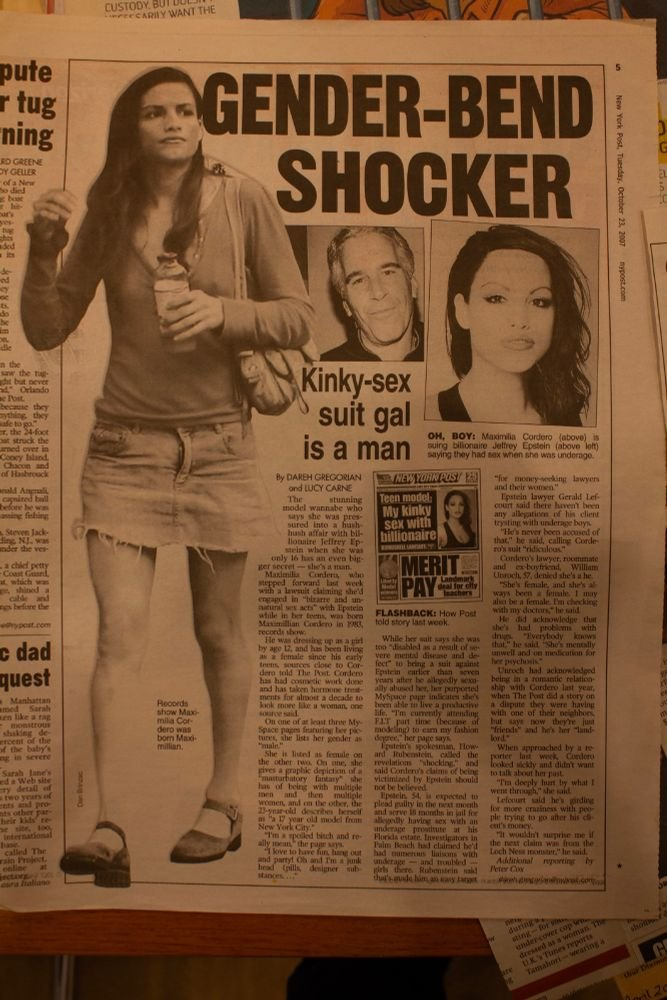
The Post revealed that Cordero was transgender. It published her deadname. It used incorrect pronouns for her throughout. It disclosed her HIV status, her psychiatric history, and her past drug use. It quoted from what it claimed were her MySpace pages, including sexual content that was fabricated.
The follow-up story ran under the headline: "S(he) has a history: Bogus sex suit."
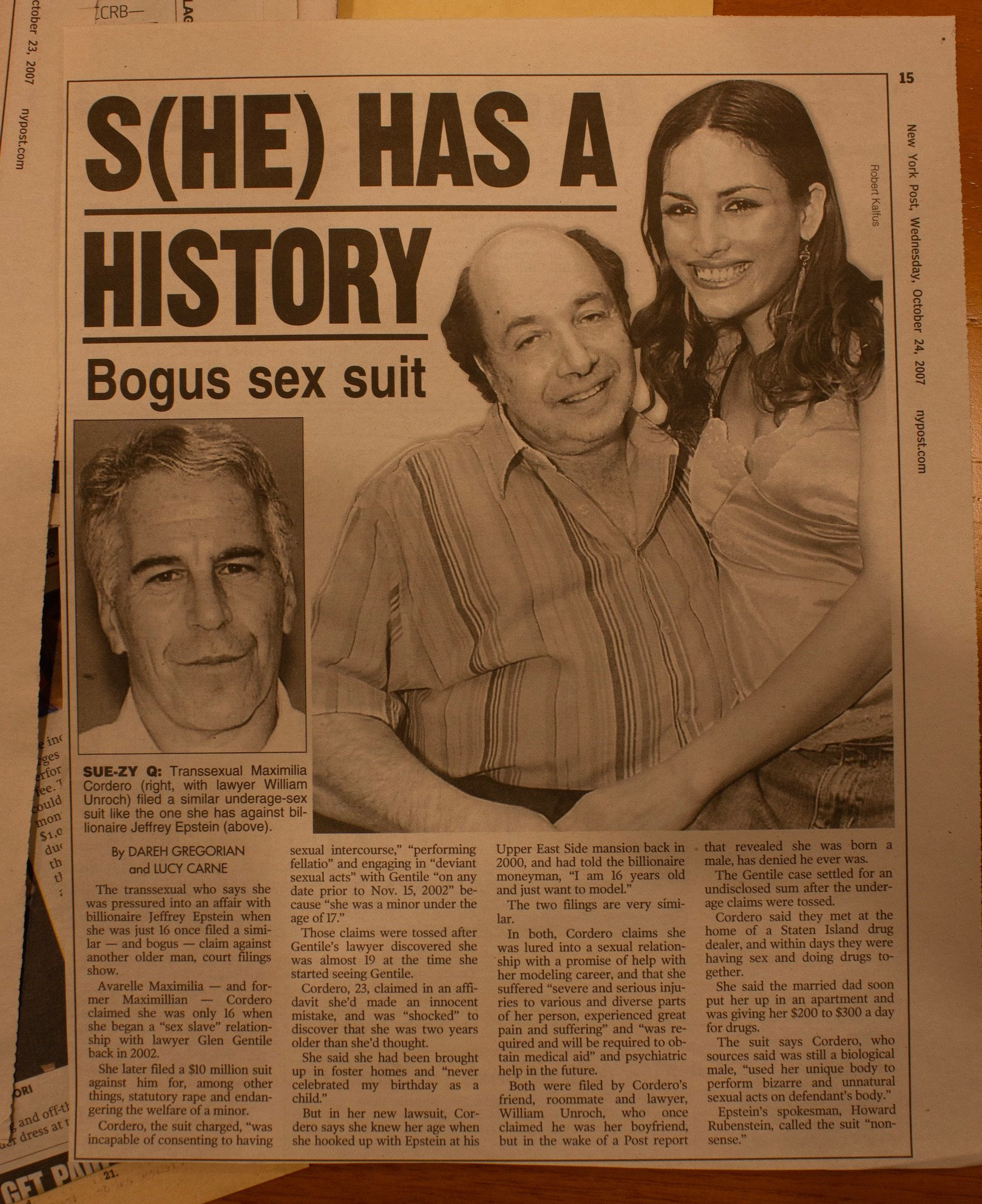
Epstein's attorney, Gerald Lefcourt, was quoted comparing Cordero to a mythical creature: "It wouldn't surprise me if the next claim was from the Loch Ness monster."
Epstein's spokesman, Howard Rubenstein, called her claims unbelievable and dismissed accusers of Epstein as "money-seeking lawyers and their women."
What the Post did not tell its readers was that Howard Rubenstein also worked for the New York Post.
Howard J. Rubenstein, who died in 2020, was known as "the dean of damage control" in New York media circles. His firm, Rubenstein Associates, represented the New York Yankees, News Corporation, Rupert Murdoch, and the Trump family.
He also represented Jeffrey Epstein.
And the New York Post.
In her subsequent $100 million defamation lawsuit against the Post, Cordero alleged that the newspaper and Epstein's team had coordinated their attack. The suit claimed that the Post "utilized the services of the New York Post's own publicist and agent Howard Rubenstein to paint an outrageous, false, and defamatory portrait of the victim plaintiff."
The Post, Cordero alleged, "did not advise their readers that Rubenstein worked for the paper and gave the impression that Rubenstein was only employed by Epstein."
According to the lawsuit, the Post's reporters contacted Cordero's father, brother, and other relatives and "wrongfully told them the plaintiff suffered from a sexually transmitted disease." The lawsuit accused the Post of violating New York medical privacy laws and rape shield laws in their attempts to dig up dirt on a woman who said she had been raped as a child.
Cordero's attorney, William Unroch, called the Post's behavior "a vicious smear campaign to 'rape' a teenage sex assault victim a second time."
The Post did not issue a retraction.
For nearly two decades, what happened next remained completely obscured from public view, until January 30, 2026, when the Department of Justice released the Epstein Files.
Buried in the millions of pages of documents was a draft settlement agreement for $28,000, dated October 2009, marked "Confidential & Inadmissible." The case caption read:
Ava a.k.a. Maximilia Cordero v. Jeffrey Epstein, Victoria's Secret Stores Brand Management Inc. a.k.a. Victoria's Secret Stores, Leslie Wexner, Nine East 71 Street Corporation, and Jeffrey Epstein and Co.
In exchange for the settlement, Cordero agreed to a comprehensive release of all claims, a strict confidentiality clause, and a non-disparagement provision that forbade her from making any public statements "that impugns or attacks the reputation or character" of Epstein or any defendant.
She was forbidden from encouraging or cooperating with any other civil claims against Epstein.
A few days after that document was written, her lawsuits were withdrawn by her attorney – with prejudice. Meaning in a way that cannot allow her to refile them.
She was silenced. After being harassed and vilified by the media, likely stalked by Epstein's PI's, this was the only way for her to obtain some kind of restitution from Epstein.
The logical question is why did the Post attack Cordero's gender identity instead of investigating her claims? Why did Epstein's team believe that revealing she was transgender would discredit her allegations of child sexual abuse?
Because they understood something about American culture that has been weaponised against transgender people for decades; the "deciever" trope.
In her foundational 2007 text on transmisogyny, Whipping Girl (highly recommend btw), Julia Serano identified a common media narrative in which trans women who "pass" are portrayed as "deceptive transsexuals" (as opposed to pathetic transsexuals, who don't pass)—predators who trick innocent people, usually straight men, into attraction or intimacy. This framing positions trans women as inherently untrustworthy, their very existence a kind of fraud.
The philosopher Talia Mae Bettcher has taken this analysis further, arguing that the "deceiver" framework doesn't just undermine trans women's credibility—it provides cultural permission for violence against them. If a trans woman's identity is understood as a lie, then any harm done to her can be rationalised as a justified response to deception.
This is why the "trans panic" defense still exists in 30 states. This is why 38% of fatal violence cases against transgender people remain unsolved. This is why, according to the Williams Institute, transgender people are 4.5 times more likely to be victims of violent crime—and why 57% of transgender people say they would feel uncomfortable asking police for help.
When running cover for Epstein, The New York Post didn't need to prove that Epstein had not assaulted a 16-year-old girl. They just needed to reveal that the accuser was transgender. In a sick society like the one we live in, the rest would take care of itself.
Cordero's attorney, William Unroch, understood somewhat what was happening. When asked why the defamation lawsuit didn't focus on the Post's claims about her gender, he responded: "It's a slam dunk case whether she was born a cat, a dog, or a space alien."
His point was that Cordero's gender identity was irrelevant to whether she had been defamed. The Post had called her a "slut, liar, and transvestite who lied about being sexually assaulted by Epstein to steal money." Those were the actionable claims.
But Unroch was operating in a legal system that, like the media, had also decided that trans women's testimony was suspect. A system where private investigators could sit in black SUVs outside accusers' homes, question their boyfriends, and chase their parents off the road. Where a billionaire could hire Gerald Lefcourt, Alan Dershowitz, and Kenneth Starr to make the legal process so gruelling and tedious that most victims would have to give up due to lack of resources, energy and will.
The culture that hated trans women was the reason that Epstein would not face any consequences for another decade.
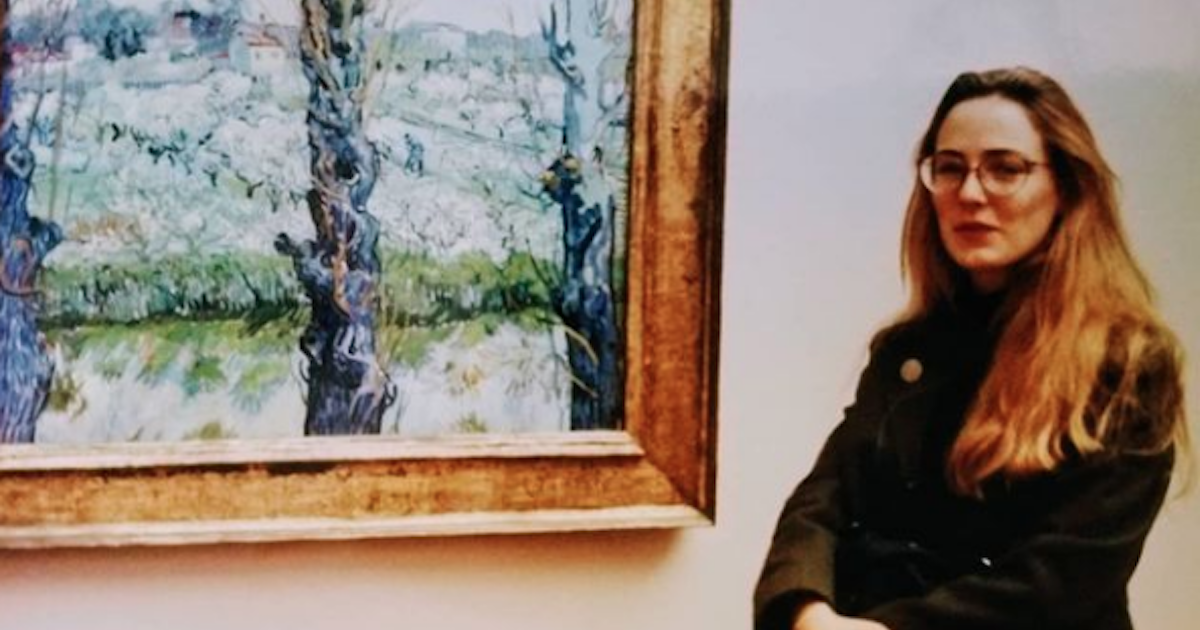
In 1996, eleven years before Cordero filed her lawsuit, a woman named Maria Farmer had called the FBI to report that Jeffrey Epstein and Ghislaine Maxwell had sexually assaulted her. She told them about photographs of naked children she had seen in Epstein's home. She told them she believed Epstein and Maxwell were continuing to hurt children.
The FBI agent hung up on her.
Had anyone listened to Maria Farmer in 1996, Cordero might never have been abused.
Had anyone listened to Cordero in 2007, the victims who came after might have been spared, too.
The Department of Justice has now identified more than 1,200 victims. Twelve hundred children, that we know of, whose lives were shaped by the fact that the institutions, journalists, and everyday people who should have protected them chose to protect Jeffrey Epstein instead.
One element of Cordero's lawsuit has received almost no attention in the years since: her allegations about Victoria's Secret.
According to the amended complaint, Epstein used the glamour of the lingerie brand to recruit victims. Cordero alleged that Leslie Wexner, the founder of Limited Brands and owner of Victoria's Secret, "knowingly allowed" Epstein to trap young models and teenage girls with promises of modeling careers.
After one assault, Cordero alleged, Epstein tried to calm her down by telling her: "You know we're friends. You should not feel bad. Victoria's Secret is that a lot of the models are transgender. Why do you think they are so tall? Most runway models are, that's why the height and body requirements are so rare."
He promised her work with Victoria's Secret if she returned. She refused.
The connection between Epstein and Wexner has since been extensively documented. Wexner reportedly made Epstein his financial adviser. Epstein managed Wexner's fortune and lived in a Manhattan townhouse that Wexner had purchased. The New York Magazine profile of Epstein published in December 2007, the same month Cordero was being attacked in the press, noted that model Alina Pascau, who had dated Epstein, was "helped" by him to land a Victoria's Secret modeling gig.
But in 2007, Cordero was alone in making these allegations publicly. Her claims about Victoria's Secret were buried under headlines about her gender.
Epstein would not be arrested again until July 2019, when Julie K. Brown's Miami Herald investigation finally forced authorities to act. He died in his cell a month later, officially by suicide, before he could stand trial.
Ghislaine Maxwell was convicted of sex trafficking in 2021 and sentenced to 20 years in prison. She is currently negotiating a sweetheart deal with Trump's DOJ, and is enjoying minimum security prison.
Leslie Wexner has never been charged with any crime. In 2019, he said he was "embarrassed" by his association with Epstein.
Ava Cordero has not made a public statement since Epsteins death.
But the documents speak for her. The settlement agreement, with its confidentiality clause and its $28,000 payment and the retracted court filings a few days later.
She tried to stop him. She told the truth. She named names.
In return, she was mocked, outed, called a liar, a man, dragged through the courts until she had nothing left, and then paid $28,000 to go away quietly.
Meanwhile, Jeffrey Epstein continued to abuse young women for another twelve years.
In 2007, American society would rather have hundreds of children raped than believe a single trans woman.
Sadly, I don't think much has changed since.
SOURCES
I've collected some notable sources when writing this article. I note that the 3 million emails released on the 30th of January by the DOJ was done quite recently, so I think there's more to be found about this story in the files. The Epstein file numbers can be entered into the search on: https://www.justice.gov/epstein

A review of The Australian's publishing has uncovered evidence of a clear and ongoing campaign against transgender people.


Bombshell Freedom of Information requests reveal Victoria Police's Human Rights Impact Assessments around the anti-trans rallies are more concerned about PR than Queer Lives.

OPINION - Into the unknown, but it's okay, we've ventured into the unknown before.
Subscribe for free and get the latest from Lucy and others straight to your inbox.